Bank Statement Analyzer API for Smarter Financial Data Processing

September 21, 2026
Last updated: September 21, 2026
Financial information is often locked inside bank statements in the form of PDFs, scanned documents, and images. While these documents contain important details, turning them into usable financial data can require significant manual effort.
A Bank Statement Analyzer API provides a way to automate this process by combining OCR, document processing, data extraction, and financial analysis.
Instead of treating a bank statement as a document that needs to be manually reviewed, applications can process it as a source of structured financial information.
Extract Financial Data Automatically
The first step in automated bank statement processing is extracting information from the document.
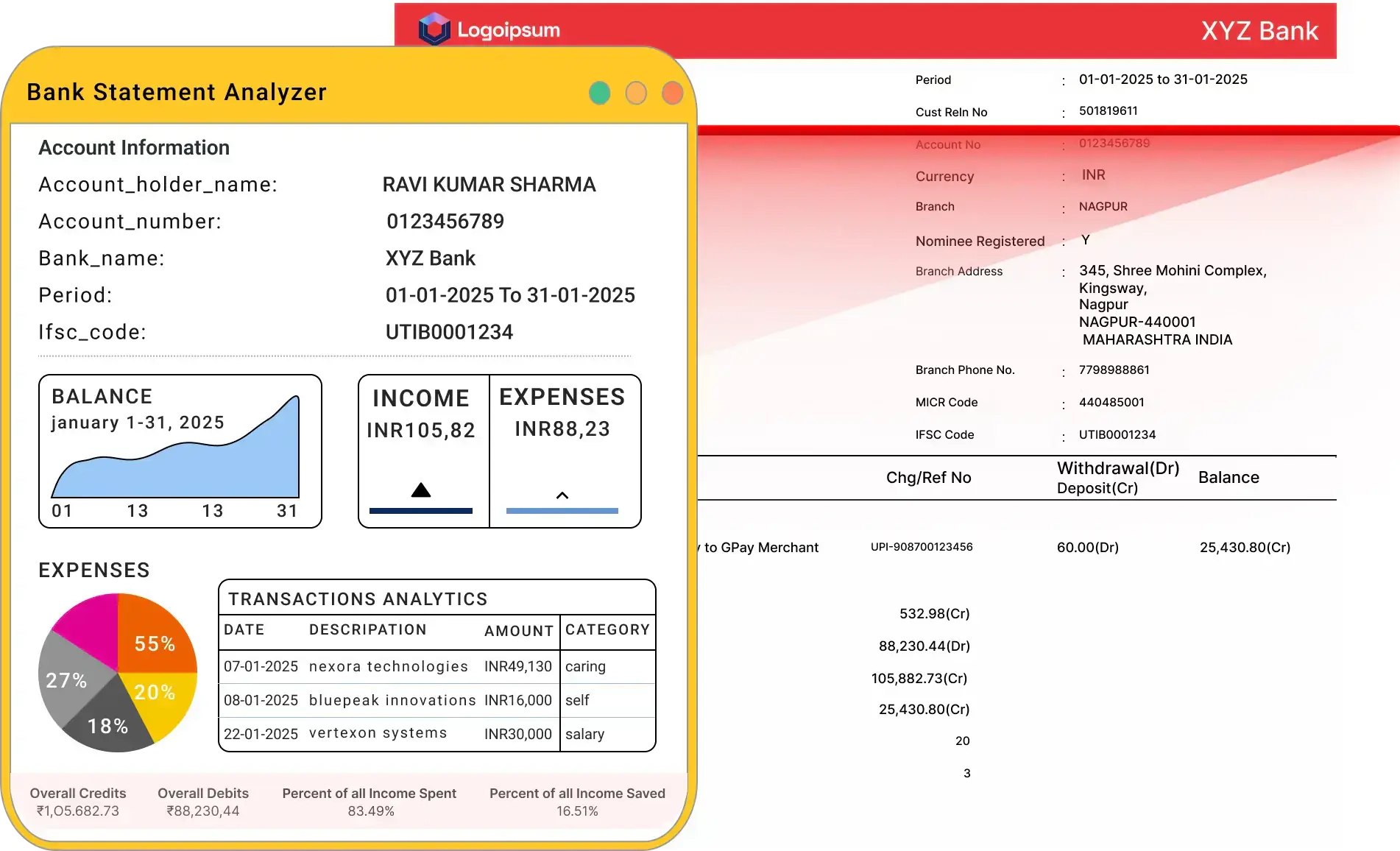
A Bank Statement OCR API can read information from supported bank statements and convert document content into structured data. This can include transaction details, dates, amounts, descriptions, balances, income, expenses, and other relevant financial information.
This approach can be useful when businesses need to process a large number of financial documents without manually entering every transaction.
Go Beyond Basic OCR
OCR alone is useful for extracting text, but financial workflows often require more than text recognition.
A Bank Statement Analyzer can organize extracted transaction information and make it easier to analyze financial activity.
For example, transactions can be categorized according to their type or financial purpose. This helps applications work with cleaner financial data instead of unstructured text from a document.
Transaction categorization can support workflows involving:
Analyze Cash Flow and Spending Patterns
Once bank statement data has been extracted and organized, it can be used for deeper financial analysis.
Businesses and financial applications can analyze transaction activity to understand cash inflows, outgoing expenses, recurring spending, and overall account activity.
This makes automated bank statement analysis useful for applications where financial data needs to be reviewed regularly rather than manually processed each time.
Detect Unusual Transaction Activity
Financial document processing can also involve identifying transactions that do not follow expected patterns.
Automated analysis can help surface unusual transaction activity so that it can be reviewed as part of a larger financial workflow.
This can be particularly relevant to fintech, banking, lending, accounting, and financial analysis applications where transaction-level information is important.
Integrating the API Into Existing Applications
An important advantage of an API-based financial document processing approach is that developers can connect bank statement analysis with their existing software.
A basic integration can follow this process:
Upload Bank Statement → OCR & Data Extraction → Transaction Categorization → Financial Analysis → Structured Output
The resulting information can then be used by an application for reporting, analysis, dashboards, accounting processes, lending workflows, or other business operations.
This means developers can add bank statement analysis and financial data extraction capabilities without building an entire document-processing system from the beginning.
Where Bank Statement Analyzer APIs Can Help
A Bank Statement Analyzer API can be useful across several financial and business workflows, including:
At AZAPI, we are working on AI-powered APIs for OCR, bank statement analysis, financial data extraction, document processing, transaction categorization, and workflow automation.
The goal is to make financial documents easier for software to understand and turn document-based information into structured data that can be used in real business workflows.
For developers building financial applications, which part of bank statement automation creates the most work today: OCR extraction, transaction categorization, financial analysis, or handling different statement formats?\
\