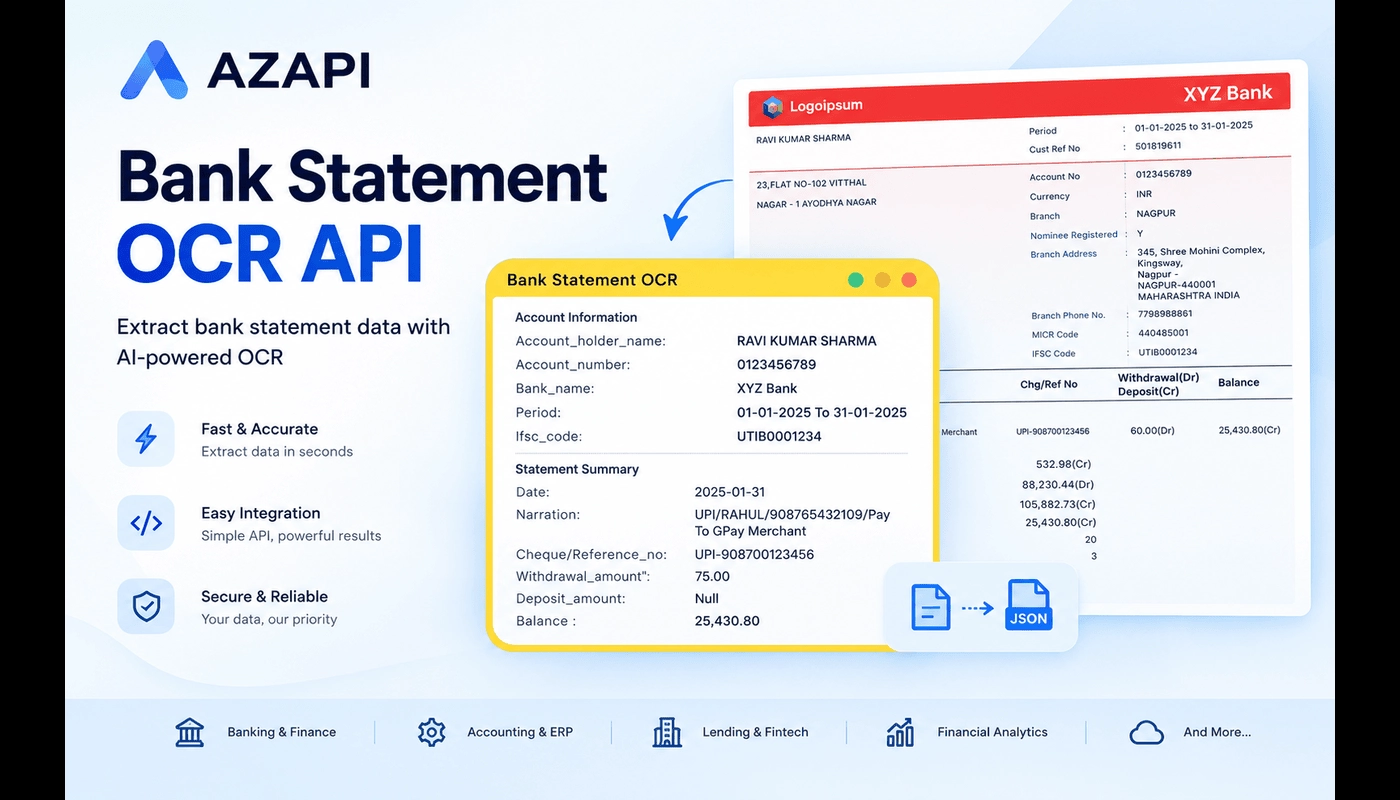
How Bank Statement OCR API Simplifies Financial Data Extraction

September 8, 2026
Last updated: September 10, 2026
Bank statements contain valuable financial information, but extracting that information manually can become difficult when businesses need to process large numbers of documents. Transaction dates, descriptions, account details, deposits, withdrawals, and balances may all be stored inside PDFs, scans, or images.
A Bank Statement OCR API provides a practical way to turn this document-based information into data that software applications can process.
For fintech platforms, accounting systems, lending applications, and financial automation tools, bank statement data extraction can become an important part of a larger digital workflow.
What Is Bank Statement OCR?
Bank Statement OCR uses Optical Character Recognition technology to identify readable information within bank statements and convert it into digital text or structured information.
Instead of manually reading every statement, an application can send a document to an OCR API for processing.
A simplified workflow looks like this:
Bank Statement → OCR Processing → Data Extraction → Validation → Application
This approach can reduce repetitive data-entry work while giving developers a way to connect financial documents with existing software.
Why Bank Statement Data Extraction Matters
Financial organizations often receive statements in different formats. Processing them manually requires employees to open documents, locate relevant information, and enter it into another system.
As document volume grows, this process can consume considerable time.
Automated bank statement data extraction can help applications capture information such as:
Once extracted, this information can be sent to databases, analytics systems, reconciliation tools, or other business applications.
Bank Statement OCR for Financial Document Processing
Financial document processing involves more than simply reading text from a file. The extracted information often needs to become part of a larger workflow.
For example, a lending platform may receive a bank statement during an application process. Instead of requiring someone to manually transfer information from the document, the platform can use financial data extraction to make relevant information available to its internal systems.
The same concept can apply to accounting, financial analysis, reconciliation, and fintech applications.
This makes financial document OCR useful as an intermediate layer between physical or digital documents and software systems.
How an OCR API Fits Into an Application
Developers can integrate a Bank Statement OCR API into their existing application architecture.
A typical implementation might look like:
`
`
`
User Upload
↓
Application
↓
Bank Statement OCR API
↓
Extracted Data
↓
Validation
↓
Database / Business Logic
`
The OCR service handles document recognition while the application's own logic determines how the extracted information should be validated, stored, or used.
This separation can make bank statement automation easier to incorporate into existing systems.
Automating Transaction Data Extraction
One of the most useful applications of OCR for bank statements is transaction data extraction.
A statement can contain many individual records, each with its own date, description, amount, and other details. Manually transferring these records into software becomes increasingly inefficient as the number of transactions increases.
With automated extraction, developers can create workflows where transaction information becomes available for subsequent processing.
For example:
Statement Upload → Transaction Extraction → Validation → Categorization → Financial Analysis
The exact workflow depends on the application's requirements, but OCR can provide the initial data-extraction layer.
Use Cases for Bank Statement OCR
Fintech Applications
Fintech platforms frequently work with financial documents. Fintech OCR can help these applications bring document information into digital workflows.
Lending and Credit Workflows
Lending systems may need to process bank statements as part of financial assessment workflows. Automated extraction can reduce the amount of manual document handling involved.
Accounting Software
Accounting platforms can use extracted statement information as input for transaction management, reconciliation, and record-keeping processes.
Financial Analysis
Applications analyzing transaction activity can use extracted information as input for reporting, categorization, or other analytical processes.
Reconciliation Workflows
When transaction information needs to be compared across financial records, automated bank statement data processing can provide useful digital input for reconciliation systems.
Why Developers Choose API-Based Processing
Building an internal OCR system requires development resources, testing, maintenance, and continuous improvements as document requirements change.
An API-based approach gives development teams another option.
With an OCR API, document processing can remain a specialized service while the main application continues handling authentication, business rules, storage, validation, and user-facing functionality.
This can be particularly useful when OCR is important to the product but isn't the application's primary feature.
Validation Still Matters
Automation does not eliminate the need for validation.
Financial information should be checked before it is used for important downstream operations. Depending on the application, developers may validate:
A reliable bank statement data processing workflow therefore combines OCR with appropriate validation and application-level business rules.
AZAPI Bank Statement OCR API
AZAPI provides a Bank Statement OCR API designed to help developers integrate bank statement data extraction into their applications and automated workflows.
The service can be relevant to fintech platforms, accounting systems, lending applications, reconciliation tools, financial analysis software, and other applications that work with banking documents.
By using an API-based financial data extraction workflow, developers can add document processing capabilities without making manual data entry the central part of their application architecture.
Learn more about the AZAPI Bank Statement OCR API:
<https://azapi.ai/services/ocr/bank-statement-ocr-api/>
Building Better Financial Document Workflows
The goal of OCR isn't simply to recognize words inside a document. Its real value comes from making document information useful to software.
A well-designed bank statement automation workflow can combine OCR, validation, structured data handling, storage, and business logic into one connected process.
For development teams dealing with large volumes of financial documents, this approach can reduce repetitive work and create a more scalable way to handle document-based information.
Conclusion
Bank Statement OCR provides a bridge between financial documents and software applications.
With a Bank Statement OCR API, developers can automate parts of bank statement data extraction, transaction data extraction, and financial document processing while keeping their existing application logic in control of the final workflow.
Whether the use case involves fintech, lending, accounting, reconciliation, or financial analysis, OCR can serve as an important foundation for building more efficient document-driven systems.
FAQs
Q1. What is a Bank Statement OCR API?\
Ans: A Bank Statement OCR API is a service that allows applications to process bank statement documents and extract readable financial information programmatically.
Q2. What information can Bank Statement OCR extract?\
Ans: Depending on the document and OCR capabilities, information may include transaction dates, descriptions, amounts, balances, account details, and reference information.
Q3. How does OCR help with bank statement automation?\
Ans: It can reduce manual document reading and data-entry work by making information from statements available for digital processing.
Q4. Can Bank Statement OCR be used by fintech companies?\
Ans: Yes. Fintech applications can use OCR as part of financial document processing, data extraction, analysis, and other automated workflows.
Q5. Is extracted financial data ready to use immediately?\
Ans: Not necessarily. Applications should apply appropriate validation and business rules before using extracted information for important financial operations.