What Must Happen Before the Reveal? A Kling 4.0 Shot-Logic Exercise
October 28, 2026
Last updated: October 28, 2026
The first image shows a closed box. The last shows a yellow star inside it. That pair establishes two states, but it leaves an important question unanswered: what makes the star become visible?
Before planning a Kling 4.0 shot, map the few actions on which the reveal depends. This is a small reasoning exercise, not a software workflow. It helps you notice when an attractive ending has no readable path from the beginning.
Our violet hinged box and star token are invented for this guide. The AI-assisted illustrations describe a proposed scene; they are not frames from a generated clip or a demonstration of model performance.

The closed and open states define the intended change. They do not yet explain how a viewer will see it happen.
Distinguish a state from a cause
A state describes what is true at a particular point: the lid is closed, or the star is visible. An action connects states: the lid rotates open, uncovering the space inside.
For the simplest version of our scene, the star is already inside the box. It stays still. The lid is the part that moves. The viewer sees the star because the lid stops blocking the view, not because the star materializes when the lid opens.
Write the connection in ordinary language:
The star starts inside the box. The lid opens. The opening exposes the star to the camera.
That sentence is more useful than “a magical reveal” when your intended scene is an ordinary physical opening. If you do want a magical appearance, make that a deliberate choice. The problem is not an impossible event in fiction; it is an accidental event that changes the task without being noticed.
Map only the dependencies that matter
You do not need a complicated diagram. Three short statements can show the basic relationship:
1. The star must already occupy the intended position inside the box.
2. The lid must move far enough to expose that position.
3. The camera must have a clear view through the opening.
The third statement is easy to miss. An open lid does not help if the camera looks at the back of the box or the front wall still hides the token. Physical change and visible information are separate parts of the plan.
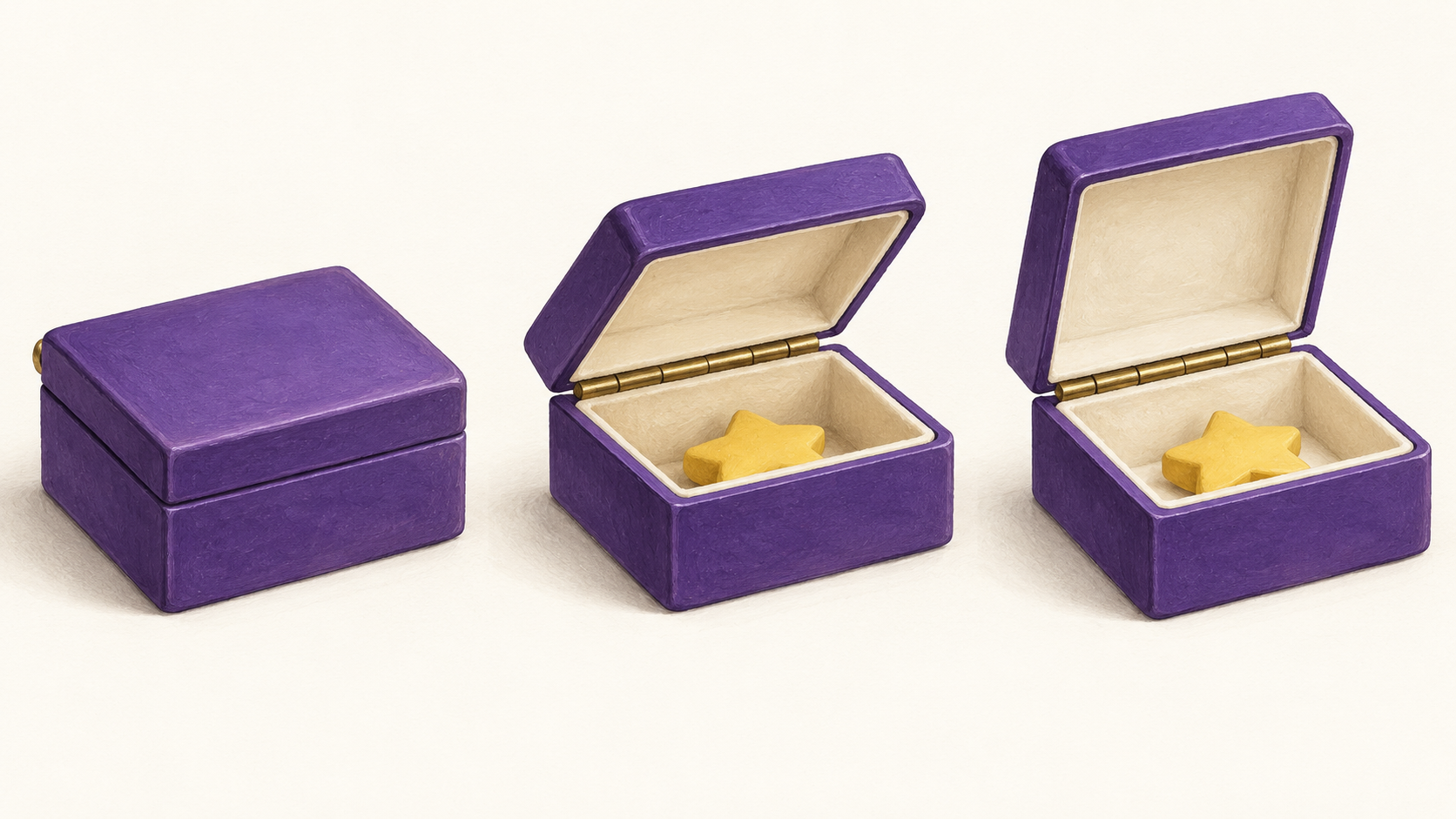
The token becomes visible as the lid opens. A useful reveal keeps that cause readable from the chosen view.
For each statement, ask what would break it. The token might change position. The lid might detach instead of rotating. The view might move behind the lid just as the opening becomes useful. Those are different failures, even if all leave the ending difficult to read.
Do not add unrelated dependencies. A ribbon, moving spotlight and drifting camera could all be interesting, but none is needed to explain this reveal. Begin with the relationships that make the scene understandable. Add another action only when it serves a separate purpose you can name.
Check what the viewer learns between the endpoints
Imagine pausing halfway through the intended action. What should the viewer be able to tell?
For this box, the lid should be partly open, the opening should have begun to expose the interior, and the star should remain in the same place. The precise amount visible depends on the real geometry and chosen view; the drawing is a planning aid, not a measurement.
This middle-state question reveals a common weakness in endpoint-only descriptions. “Closed box, then star” can produce a pleasing before-and-after pair while withholding the opening action. If the action matters, describe and inspect it. If only the new state matters, an edit may be the clearer choice.
Use a small note beside your plan:
What changes: The lid angle.\
\\What stays: Box position, token position, camera viewpoint.\
\\What the viewer learns: The token was inside, and opening the lid makes it visible.\
\\What would contradict that: A new token appears, the box changes shape, or the opening is hidden.
Decide whether the action belongs in one shot
A continuous view is useful when the viewer needs to understand the connection between opening and seeing. Keep the relevant space readable through the action.
A cut from closed to open has a different job. It can announce a new state quickly, but it omits how that state was reached. That is fine for a short visual transition whose purpose is clear. It is less useful when the post is supposed to demonstrate the opening mechanism.
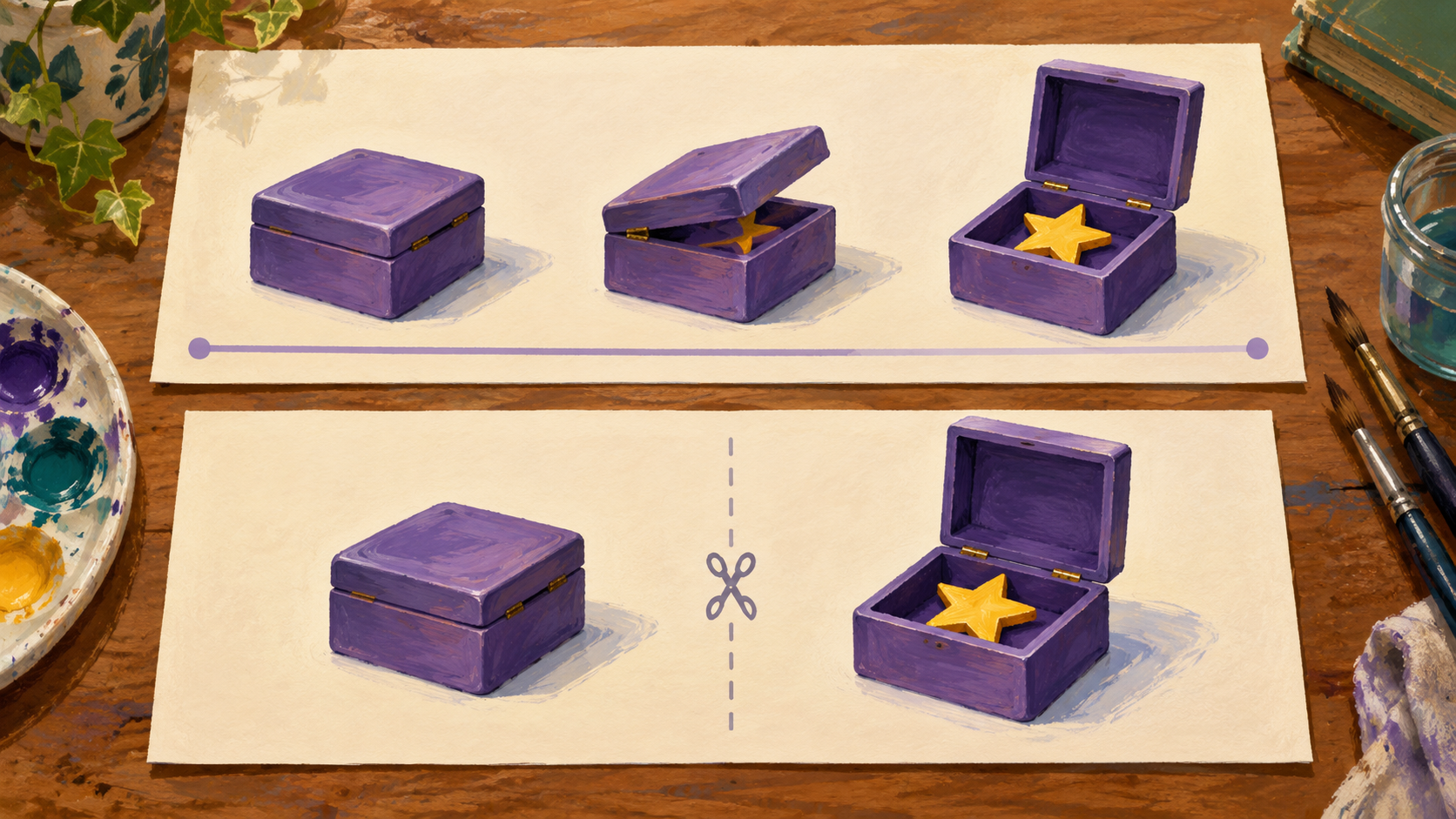
A continuous opening explains the action. A cut can show the new state while omitting that action; choose according to the post's purpose.
For precise construction, handling or evidence of an actual product, record the real object. For an invented visual study, you can use drawings to decide what the shot should communicate and later judge a candidate against those expectations. Do not let a generated illustration stand in for a physical test.
Turn the dependency map into a shot brief
Use the dependency map as a compact shot brief. State what is already inside the box, what moves and which view lets the audience understand the opening. These relationships give the concept a clear purpose before you begin developing its visual treatment.
Take that brief to Flyne AI Kling 4.0 to develop a video concept around the reveal. Keep the closed, partly open and open states beside your motion description. When assessing a draft, follow the cause rather than just the attractive ending: does opening the lid make the star visible while the box and token remain in place?
Disclosure: This article is provided by the Flyne AI brand team.
Try explaining the scene without the model's name. If another person can say what moves, what stays and why the star becomes visible, you have a usable plan. If they cannot, fix the missing relationship first. The next prompt will then ask for a scene you can understand and assess.